

A practical guide for community business owners
Bringing key employees into equity is a powerful tool available to a business owner. When it works, it drives value, deepens commitment, and supports a clean exit. However when it goes wrong, it goes wrong fast, and the costs can be significant.
1. Start With the Right Question
Before anything else, the most important question to answer is: what problem are we actually trying to solve?
Employee equity is not a universal reward. It is a specific tool for a specific job - retaining the senior leaders who are genuinely driving business value and incentivising them to create more of it. It is not the right answer for every situation, and it is not the first tool to reach for.
In our experience, many business owners begin exploring equity schemes without being fully clear on what they want the scheme to achieve. That ambiguity, left unresolved, is where problems start.
The question to ask before anything else: if you could not offer equity, how would you solve this problem? If there is a good answer to that question, start there.
2. Equity Is the Last Rung of the Ladder
A useful way to think about employee incentivisation is as a ladder - short-term incentives at the bottom, long-term cash-based schemes in the middle, and equity at the top.
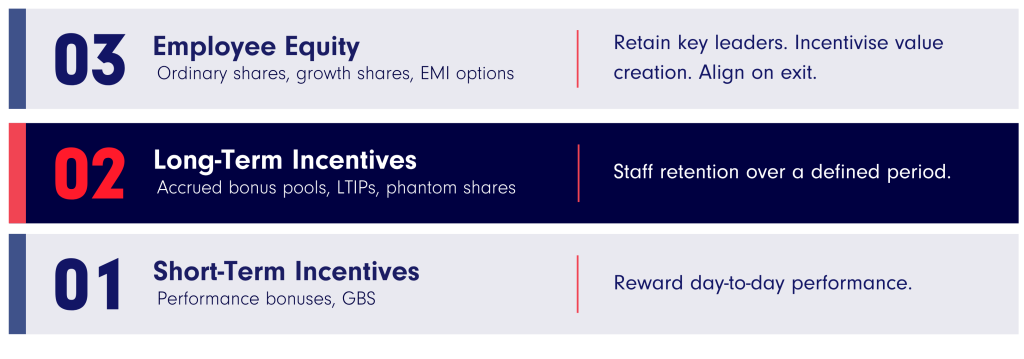
Equity is also the hardest option to unwind. Bringing an employee in is relatively straightforward. Getting them out if circumstances change is expensive and complicated. We have seen schemes that made sense at the time create significant problems within a few years. Equity tends to cause more problems than it solves in these situations:
- You want to retain very tight control, even minority shareholdings carry rights and expectations
- The employee needs short-term cash more than a long-term investment
- The business is not on a clear growth trajectory
- Existing family shareholders are not aligned on dilution
- The employee does not fully understand how shares and exits work
Involve advisers before you involve employees, not the other way around. Once equity has been mentioned to a key team member, expectations are set and very difficult to walk back.
We regularly see business owners come to us expecting to implement an equity scheme and leave with a different approach entirely. LTIPs, phantom share schemes and government-backed arrangements can achieve the same retention and motivation outcomes in many situations, with less complexity and no dilution.
3. The Structures and Why the Detail Matters
When equity is the right answer, several structures are available; ordinary shares, growth shares, and EMI options each carry different tax treatment, entry costs and governance requirements. The structure that looks simplest is not always the most appropriate, and some of the most commonly discussed are also the most commonly misapplied.
Getting the valuation wrong at the outset is where most problems originate. If HMRC determines that an employee did not pay market value for their shares, the employee faces an income tax charge on the difference and the employer faces its own consequences.
| When the groundwork is skipped: a £3 million lesson A business implemented an employee share scheme without getting proper valuation advice at the outset. When they came to exit, due diligence revealed a mismatch between the price employees had paid and the actual market value at the time. The result: the business owners had to place £3 million into escrow for six years. The lesson: get the valuation right before you start, not after. |
4. Valuation and Tax: The Area Where Most Problems Arise
Independent valuation and proper tax structuring are the foundation of any scheme that will hold up under scrutiny. HMRC is paying increasing attention to employee equity, and the consequences of getting this wrong land on both the employee and the employer.
The commercial logic and the legal documentation need to be tightly aligned. A scheme that makes sense in a conversation can create significant liability if the underlying tax work has not been done first.
5. Things We See Go Wrong
Based on years of working on these schemes, these are the situations that cause the most problems:
The employee drives the process
When key employees are given too much control over designing the scheme, it rarely ends well. The business owner must lead, clear on the strategy, the outcome, and the boundaries before any conversation happens with the employee.
Promises made before the detail is worked through
We have seen this derail schemes more than almost anything else. Once equity has been promised, it is very difficult to walk back even if the specifics prove unworkable. The conversation with the employee should only happen once every element has been thought through.
The shareholder agreement is an afterthought
The shareholder agreement governs what happens in every scenario, including the ones nobody wants to think about. Getting this right, with the right legal advice, is essential. A weak shareholder agreement can create real problems at exit.
Equity used to fix the wrong problem
Offering equity to someone who is unhappy with their pay, or to paper over a leadership misalignment, is unlikely to work. Equity cannot fix a cultural problem or a compensation grievance. If you can solve the problem another way, do that first.
No clear exit or succession plan
If there is no realistic liquidity event in view or if shareholders and employee shareholders are not aligned on what that looks like and when equity becomes a disincentive rather than a motivator. Employees who can never turn their shares into cash will quickly become frustrated. This needs to be addressed before the scheme is designed, not after.
6. FAQs
The short answers below give a sense of the territory. The right answer in each case will depend on the specifics of your situation.
Does EMI work for wider community staff?
It is possible in theory, but it requires very careful thought. There are specific conditions that need to be met to avoid any potential involvement, and the individual circumstances matter significantly. This is not something to approach without specialist advice, and should be absolutely the last resort - more often than not it is unworkable.
Is a wide shareholder pool likely to put buyers off on exit?
Not necessarily but the governance structure needs to be right. The questions a buyer will ask are predictable, and making sure the shareholder agreement is built to answer them is something to think about from the start, not just before exit.
How do you make the case for EMI shares when you cannot give an employee a clear figure on exit value?
There are ways to model this that give employees a meaningful sense of what different outcomes could look like. The structure of the scheme can also be designed to create a direct link between performance and reward. This is something we work through in detail with clients.
Should you offer equity to a new senior hire before they have proved themselves?
Our strong recommendation is no. The risks of getting this wrong — commercially and relationally are significant. There are better ways to structure an attractive offer at recruitment stage.
Who draws up the shareholder agreement?
A lawyer, and the quality of that lawyer matters. The shareholder agreement needs to translate commercial intent accurately into legal documentation. We work closely with legal advisers on this, and we can help identify the right people for your situation.
How We Work
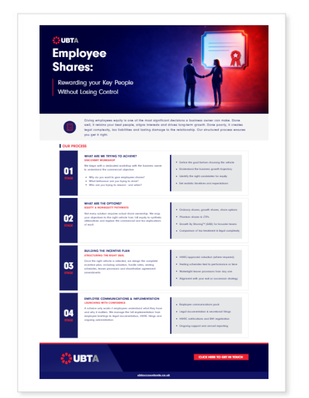
We follow a structured four-stage process, from the initial commercial objective through to implementation, HMRC filings and ongoing support. Download our process overview below.
Watch the Webinar
The full recording of our May 2026 webinar Employee Shares: Rewarding Your Key People Without Losing Control, is available to watch here. It covers everything in this guide in more depth, including live Q&A with the panel.