

When a business owner tells us they want to give employees shares, the first question we ask is not about structure or tax efficiency. It is about why.
Not because share schemes are a bad idea, they are not. When they work, they are one of the most powerful tools a growing business has. But in our experience, most of the problems start not with the structure of the scheme, but with the conversation that happened before anyone called us.
| “The most common mistake isn’t getting the structure wrong. It’s telling the employee before you’ve got something concrete to offer.” |
The conversation that sets everything off course
It usually goes something like this. There is a key person in the business, someone genuinely important, someone who would be hard to replace. The owner wants to keep them. Someone mentions that equity could be a good way to do it. A conversation happens, an idea is floated, and the employee starts factoring it into their thinking about their future.
Then the complexity hits. The valuation is harder than expected. The structure is not straightforward. HMRC approval takes time. The scheme that seemed simple in a coffee shop conversation turns out to need lawyers, tax advisers and several months of work.
By the time all of that becomes clear, the expectation has already been set. Walking it back or delivering something different from what was implied, is far more damaging than if the conversation had never happened.
The rule we apply without exception: involve advisers before you involve employees. Always.
Equity is not the answer to every question
There is a version of this conversation where equity is exactly the right answer. The employee is a genuine A-player. The business is on a clear growth trajectory. There is a realistic exit or liquidity event in the medium term. The owner is genuinely willing to share the upside. In that scenario, a well-structured scheme can be transformative.
But equity does not work for everyone, and it does not work in every business. If there is no clear path to an exit, you are offering someone an asset they may never be able to turn into cash. A frustrated shareholder is often a bigger problem than no shareholder. If the employee needs short-term income, equity is not the answer. If the real issue is a pay grievance or a cultural problem, equity will not fix it.
Before reaching for shares, ask the harder question: if equity were not an option, how would we solve this? More often than not, there is a better answer — a bonus structure, a long-term incentive plan, a profit share arrangement, that achieves the same outcome with less complexity and without diluting ownership.
When it’s right, do it properly
If you have worked through those questions and equity still makes sense, the next step is getting the detail right before anyone is told anything. That means proper independent valuation, the right structure for your circumstances, and a shareholder agreement built to handle the difficult moments - a leaver, a dispute, a sale, not just the optimistic ones.
We have seen the consequences of skipping that groundwork. One business had to place £3 million into escrow at exit because the original valuation was not done correctly. That is an extreme example, but the underlying mistake - moving too quickly, without the right advice in place, is one we see in less dramatic forms regularly.
Done well, employee share schemes do exactly what they are supposed to. They keep the people who matter. They align your team around building something worth more. And they make your business considerably more attractive when the time comes to sell. The outcome is absolutely achievable, it just requires going about it in the right order.
How We Work
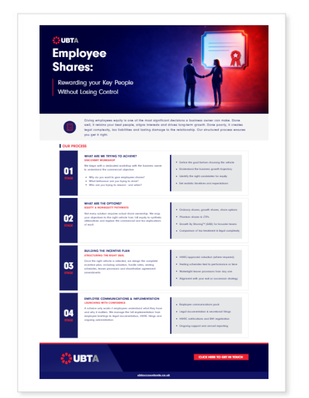
We follow a structured four-stage process, from the initial commercial objective through to implementation, HMRC filings and ongoing support. Download our process overview below.